I'm happy to announce that the photojournalism blogs are now up and running for the Wayne State Digital Photojournalism students. You can also find their Twitter and Instagram usernames on their blogs, as well.
Click on a name and add to their page views!
Alexander Franzen
Lauren Seago
Melanie Entrekin
Halie Keith
Angelique Harrison
Hope Crenshaw
Michael Ference
Emily Ridener
Allen Jackson
Kyra Johnson
Kaitlin Fazio
Wayne Bussey
Janelle Payne
Ameera Salim Al Souli
Ashourina Slewo
Cierra Anthony
Friday, January 30, 2015


Monday, January 19, 2015
Recapping the first week at Owens CC and Wayne State University
One week
down. And what a great week it
was!
The first week is always my
favorite because I meet new students, and it sets the tone for the rest of the
semester.
Here’s a quick recap:
·
The Digital Photography at Owens has 12 students, and they
are already learning the nuts and bolts of their digital cameras. But they
won’t get into the specifics of shutter speeds and apertures for another few
weeks. But they will be learning how to meter this week.
·
The Owens CRT Digital Video class has 10 students. I’m
co-teaching it with a young, bright and recent film graduate from the
University of Toledo, Andrew Jex. He brings fresh shooting ideas into the
course, which we are designing a bit.
- They learned the basics of the Final Cut Pro X interface,
and went through the first two chapters of the textbook.
- Throughout the course they
will be shooting assignments that include animation and classic storytelling.
They will also be shooting an assignment or two for the Owens Outlook student
newspaper. It’s exciting to add
video to the online student newspaper. The photo editor, commercial photography
major Sean Ferry, will determine what videos will actually make the online
newspaper.
- The course was also
rewarded a $9,000 grant for equipment. We spent that pretty fast. Within a
month we should be getting new DSLR camera kits with video capability,
Sennheiser mics, tripods and a portable light source.
·
My largest class to teach ever is the Digital
Photojournalism course at Wayne State University in Detroit. Nineteen students, mostly
journalism majors, showed up Friday morning, eager to use their cameras as
another storytelling tool.
 |
| Screen grab of Sandra Svoboda's profile on the WDET website. |
- They will also be doing assignments for the South End student newspaper. Practical experience is the best way to learn, and there is no better way to give them real-world experience.
Let Week Two begin.
 |
| WDET reporter Sandra Svoboda explains shooting opportunities for the digital photography students. (Cell photo by Lori King) |
Thursday, January 8, 2015
On being busy, surviving the busyness, and enjoying it as you go
The calm before the storm. That's how this week feels as I gear up for the start of this semester.
This will be my weekly teaching schedule for the next four months:
They say that it's not work if you love what you do. I can attest to that.
But I'm not alone. When I taught the Teaching Multimedia class last semester, most of the students, who are high school teachers earning their master's degree in Journalism Education, had other jobs: coaching sports and debate teams; teaching college classes; advising student media; raising kids.
It's absolutely crazy how much we tend to pack into our days. Why, oh why, do I do this to myself?
That's easy to answer - because I love teaching what I do for a living!
It's certainly not for the money. Both the journalism field and the college environment are financially suffering. Both are cutting back on personnel and supplies. But both are so utterly and vitally important for our free society.
Journalism, or the act of disseminating valuable (and sometimes not so valuable) information to our communities, is a civic duty that dates back to the beginning of the human race: think cavemen drawing pictures on cave walls.
I'm often asked why and how I do it.
Why? Because teaching feeds my soul. I no longer feel like I need to be the one who produces the work. My whole goal in my seasoned life is to teach others to do it. I am basically teaching the next generation to replace me. I'm proud to be able to contribute to the future of photojournalism.
And how? First and foremost, it's because I want to do it. To be able to handle everything, I have to be very organized and I don't procrastinate.
I always get a kick out of those students who tell me they are too busy to complete assignments on time because they're too busy. Seven times out of 10 they don't even have full-time jobs or kids. That proves to me that success or failure isn't measured on how busy we are, but how we handle the busyness.
Got that students? Let me summarize:
Now, before the storm rolls in and drowns me in busyness, please excuse me while I catch up on episodes of American Horror Story: Freak Show.
This will be my weekly teaching schedule for the next four months:
- Mondays and Wednesdays from 9 - 11:15 a.m. = Digital Photojournalism (Owens)
- Mondays from 11:30 - 1 p.m. - Owens Outlook student media weekly meeting
- Thursdays from 5:30 - 7:45 p.m. = Digital Video (Owens)
- Fridays from 9:35 a.m. - 12:15 p.m. = Digital Photo (Wayne State)
- Monday, Tuesday, Wednesday and Friday from 1:30 - 10:30 p.m.
- Saturday from 9 a.m. - 6 p.m.
They say that it's not work if you love what you do. I can attest to that.
But I'm not alone. When I taught the Teaching Multimedia class last semester, most of the students, who are high school teachers earning their master's degree in Journalism Education, had other jobs: coaching sports and debate teams; teaching college classes; advising student media; raising kids.
It's absolutely crazy how much we tend to pack into our days. Why, oh why, do I do this to myself?
That's easy to answer - because I love teaching what I do for a living!
It's certainly not for the money. Both the journalism field and the college environment are financially suffering. Both are cutting back on personnel and supplies. But both are so utterly and vitally important for our free society.
Journalism, or the act of disseminating valuable (and sometimes not so valuable) information to our communities, is a civic duty that dates back to the beginning of the human race: think cavemen drawing pictures on cave walls.
I'm often asked why and how I do it.
Why? Because teaching feeds my soul. I no longer feel like I need to be the one who produces the work. My whole goal in my seasoned life is to teach others to do it. I am basically teaching the next generation to replace me. I'm proud to be able to contribute to the future of photojournalism.
And how? First and foremost, it's because I want to do it. To be able to handle everything, I have to be very organized and I don't procrastinate.
I always get a kick out of those students who tell me they are too busy to complete assignments on time because they're too busy. Seven times out of 10 they don't even have full-time jobs or kids. That proves to me that success or failure isn't measured on how busy we are, but how we handle the busyness.
Got that students? Let me summarize:
- Love what you do
- Be organized when you do it
- Don't procrastinate with what you must do
Now, before the storm rolls in and drowns me in busyness, please excuse me while I catch up on episodes of American Horror Story: Freak Show.
Saturday, December 27, 2014
Three 2015 resolutions that I just might keep... with lots of help from students

 |
| Myself, center, with the Owens Outlook editors. (Photo by Sean Ferry) |
Resolutions
are made to be broken, right? Perhaps because they often focus on ourselves,
and without much help from others.
So I won’t waste my 2015 resolutions on myself. Instead, my wishes for success
will focus on my Owens Outlook newspaper staff. The success of my resolutions
will depend on us all working together as a team.
These are my joint resolutions for
2015:
1. Submit the Owens
Outlook online student newspaper and its staff for the Pinnacle Awards.
Pinnacle Awards, handed out during the annual College Media Association Fall
convention, honor the best college media organizations and individual students
for their work throughout the year.
I have high hopes for this ‘little engine that could.’ As I scan over their
photos and stories from this past semester, how can they not be strong
contenders in a national contest on the community college level? I would even
pit them against four-year schools!
The CMA conference next year is in Houston. I can’t wait to sit there
during the awards ceremony and hear our school called out.
2. Start paying the Outlook staff and
buy necessary equipment through ad and photo sale revenue.
The
Outlook has a new paid student business manager, and I hope she hits the ground
running. We
are
looking at several ways to generate money:
· Sell ads on the
Outlook website.
· Sell their
photography through sites like Flickr or SmugMug.
· Create an
end-of-semester hard print magazine that features the best content of the
semester, as well as fresh, longer-form photo stories. We are banking that local companies sponsor it.
We were once considering going to a bimonthly print edition, but with a skeleton
staff of under 10 each semester, and no journalism program to support it,
that’s no longer an option.
3. Recruit deans, chairs, administration,
students and community members to subscribe to the online newspaper.
The Outlook staff works hard to cover the entire Toledo campus, but we can’t do it without the support of
readership support. We need their tips for story ideas, feedback on
how we can do things better, and website hits to justify our existence.
Lofty goals, indeed. So the
Outlook staff and the entire Owens community need to work together to help make these resolutions come true!
Thursday, December 4, 2014
Owens' Intro to Photojournalism course: The little engine that could
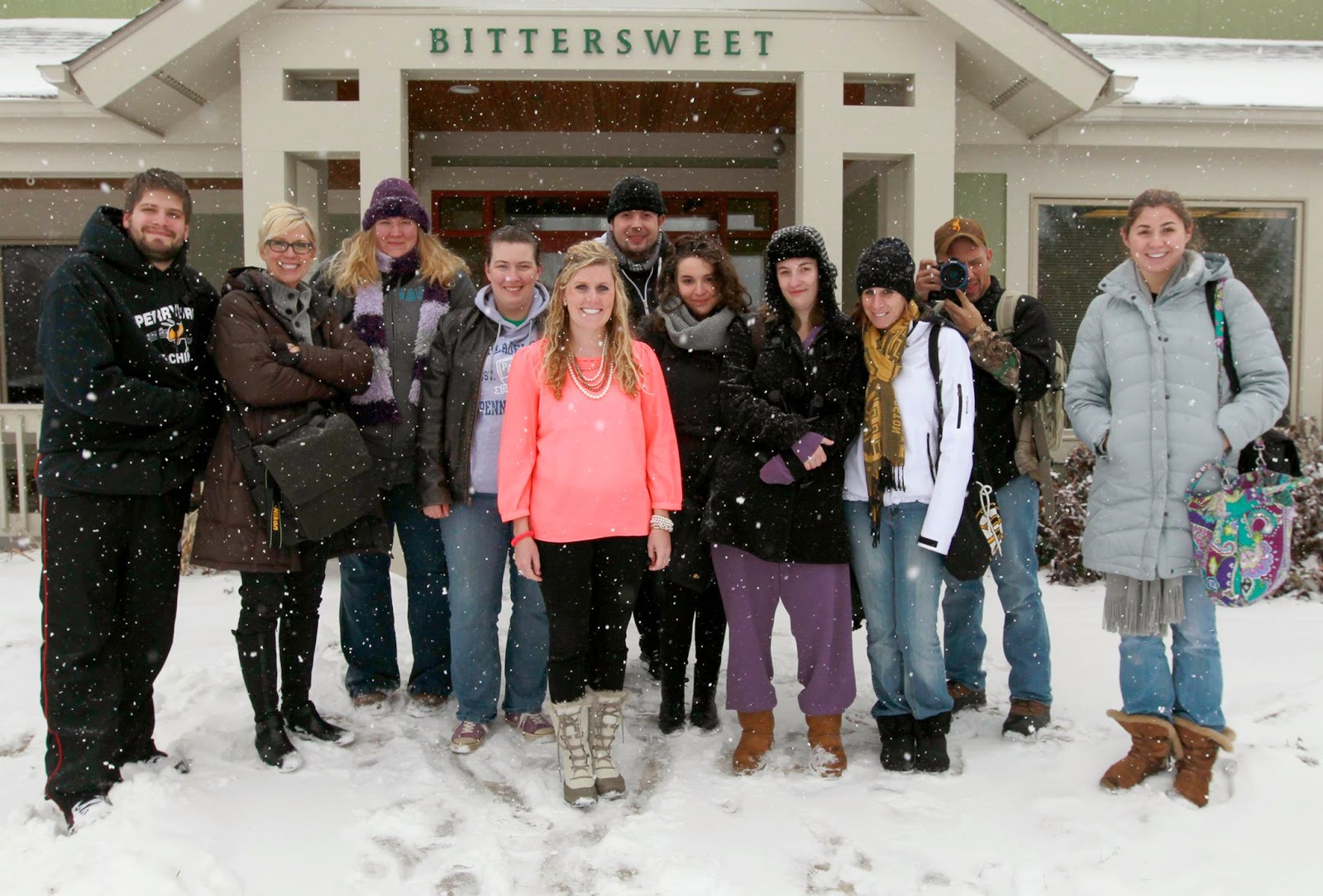 |
| Intro to Photojournalism class, featuring Bittersweet Farms marketing director Shannon Dane, center. The class went to Bittersweet Farms to shoot their team photo story, published in the Owens Outlook student newspaper. (Photo by Lori King) |
 |
| Dec. 4 Screen shot of Owens Outlook student newspaper. |
In too many college classes,
final grades and a stack of textbooks are all that tangibly remain once the
semester is over.
Sure, most students gain a heightened intellect in every
class they take.
However, potential employers want to
see visible proof that their hires
are capable, dependable and talented. This is especially true for students who
are expected to have a portfolio to prove their worth.
I am lucky enough to have the type of
course that can provide that proof: Ten students in my Intro to Photojournalism
class are the ‘little engine that
could.’
Not only do they have required
classroom assignments, they also are staff members of the Owens Outlook student newspaper, which
covers a campus with about 13,000
enrolled students.
Let me make this perfectly clear - these 10 students are the ONLY staff members on the student newspaper, except for Kyle, who will be taking the Intro to PJ class next Fall.
This small staff publishes fresh content, including stories, videos and photo galleries, every week, and they don't even get paid!
Let me make this perfectly clear - these 10 students are the ONLY staff members on the student newspaper, except for Kyle, who will be taking the Intro to PJ class next Fall.
This small staff publishes fresh content, including stories, videos and photo galleries, every week, and they don't even get paid!
The Intro to PJ class is very
progressive and task-based.
-
In
only four months they learn the following theories and skills:
- What news is
- The Anatomy of a newspaper
- How to caption photos using the Associated Press Stylebook
- Create and maintain blogs, Twitter and Instagram accounts
- Shoot feature, sports, portrait and photo stories
- Write, write, write
Alas, the end is indeed here, but their blogs, tweets and Outlook stories shall live on forever!

Screen shot of Dec. 4 post by Owens Outlook EIC Katie Buzdor. #proud To view their individual course blogs, go to King's Klass Blog.
Saturday, November 22, 2014
On shooting video stories: Learning curve is steep, but the climb is worth it
It’s hard to define bad video technique
until you actually see it: bad pans, bad focusing, bad fades, bad zooms,
bad audio.
The word ‘bad’ sounds, well, bad.
But ‘making bad’ on your first few videos isn’t necessarily a bad thing. After all, we
all have to start somewhere, right?
A few weeks ago the KSU
Teaching Multimedia class got started on their first video assignment.
The goal was to get their your feet wet by handing the gear, practicing with moving images, getting comfortable with sound, and then developing a workflow to put it all together.
The goal was to get their your feet wet by handing the gear, practicing with moving images, getting comfortable with sound, and then developing a workflow to put it all together.
Before they shot their story they
were given a list of video news stories by established media to view. Then they had to find subjects that would
lend to visual variety and sound (the assignment before this was learning how to capture sound and edit using Audacity). Finally, with a list of guidelines to follow, they had to shoot and produce their own stories.
Keep in mind that this class is also
extremely fast paced. In only four months they learn basic still photography and audio skills, as well as create blogs to post their timelines, interactive maps
and opinion polls. They don’t have the luxury of time.
I expected bad video because most
of the students took the class because they had no visual journalism experience and wanted to
learn; and to learn you have to do; and the more you do the better you get. This is why they are given a second chance, and are currently working on their second video, due at the end of the semester. I hope to see improvement, not only because they've done it before, but because they have the benefit of learning from one another's videos on our YouTube Channel.
It's understood that the learning curve to
shooting video is pretty steep. Still photography is hard enough, with
camera controls, compositional rules and lighting techniques to worry about.
But throw in the added elements of movement and audio, and, well, beginners can
have pretty bad video!
The following two stories were chosen from this class because I think it’s important to demonstrate the spectrum of
work students do. You will be able to tell which one works, and which one
needs work.
Sure, I can say in a classroom or write in a blog, "Don't do this, and yes, do that..." But you really have you see it to get the picture.
For this third bad audio video (click here), I demonstrate really bad audio, and it isn't a product of my students. It's mine!
Even us experienced types can screw up, as this brief weekly Dog of the Week video proves. Normally, the Sennheiser hotshoe mic on my DSLR cameras does a fine job of recording quality audio. But not this time.
While producing the video using Adobe Premiere Elements 11, I was horrified to hear annoying static during the interview. Perplexed, I had a gut feeling it could be a battery issue, so I did a test. I recorded sound suing the old AAA battery, then replaced the battery and did another recording. The new battery fixed the problem.
This bad audio makes it a bad video story, and even a cute puppy can't save it!
Tips for recording quality audio include keeping the batteries fresh; record in a quite space, use a quality mic that minimizes distracting background noise; keep close to the subject or use wireless mics with a transmitter.
Here's another video I did that encompasses decent shooting techniques and audio: Say cheese!
A few tutorials on shooting/editing video:
For this third bad audio video (click here), I demonstrate really bad audio, and it isn't a product of my students. It's mine!
Even us experienced types can screw up, as this brief weekly Dog of the Week video proves. Normally, the Sennheiser hotshoe mic on my DSLR cameras does a fine job of recording quality audio. But not this time.
While producing the video using Adobe Premiere Elements 11, I was horrified to hear annoying static during the interview. Perplexed, I had a gut feeling it could be a battery issue, so I did a test. I recorded sound suing the old AAA battery, then replaced the battery and did another recording. The new battery fixed the problem.
This bad audio makes it a bad video story, and even a cute puppy can't save it!
Tips for recording quality audio include keeping the batteries fresh; record in a quite space, use a quality mic that minimizes distracting background noise; keep close to the subject or use wireless mics with a transmitter.
Here's another video I did that encompasses decent shooting techniques and audio: Say cheese!
A few tutorials on shooting/editing video:
Monday, November 17, 2014
Big crowd enjoys Tiedtke's song & 3,200 lb block of yummy cheese
Fighting the crowd. Recording several speeches and editing them down to only a few minutes. Capturing enough B-roll to tell the story of a gigantic hunk of cheese.
These were the challenges I faced Saturday during The Anderson's big Wisconsin cheese slicing event at the Talmadge Ave. store.
The only technical issue I had was that the bottom half of the Canon 5D Mark III camera kept loosening up, which literally makes the camera go dead. At first I thought it was the battery, but it was full when I started. Then I wondered if I had a full memory card, so I stuck an empty one in the slot. But, alas, it was the separation between the camera body and battery compartment. Thank goodness it happened before, so experience paid off.
I am also thankful I didn't have to shoot the stills, too. When I do both video and stills, it's ultimately the stills that suffer. I'm not going to say it's impossible to shoot both equally well, but I admit it's not easy. My colleague Jetta Fraser shot the stills.
Here's the link to the Toledo Blade story, video and photo gallery: Say Cheese!
Despite the thick crowd that made maneuverability difficult, it was a fun story to shoot, and the cheese was yummy.
I was also fortunate that self-described 'cheese goddess' Paula Larson brought back Tiedtke's memories when she sang two renditions of the Tiedtke's song. The sing-a-long gave me enough time in the video to showcase the cheese-cutting and taste-testing process, otherwise known as B-roll.
Who cut the cheddar cheese? Dan Anderson did, of course!
These were the challenges I faced Saturday during The Anderson's big Wisconsin cheese slicing event at the Talmadge Ave. store.
The only technical issue I had was that the bottom half of the Canon 5D Mark III camera kept loosening up, which literally makes the camera go dead. At first I thought it was the battery, but it was full when I started. Then I wondered if I had a full memory card, so I stuck an empty one in the slot. But, alas, it was the separation between the camera body and battery compartment. Thank goodness it happened before, so experience paid off.
I am also thankful I didn't have to shoot the stills, too. When I do both video and stills, it's ultimately the stills that suffer. I'm not going to say it's impossible to shoot both equally well, but I admit it's not easy. My colleague Jetta Fraser shot the stills.
Here's the link to the Toledo Blade story, video and photo gallery: Say Cheese!
Despite the thick crowd that made maneuverability difficult, it was a fun story to shoot, and the cheese was yummy.
I was also fortunate that self-described 'cheese goddess' Paula Larson brought back Tiedtke's memories when she sang two renditions of the Tiedtke's song. The sing-a-long gave me enough time in the video to showcase the cheese-cutting and taste-testing process, otherwise known as B-roll.
Who cut the cheddar cheese? Dan Anderson did, of course!
Tuesday, November 11, 2014
Owens Outlook editors attend national student media conference in Philly
 |
| Me, center, and my hard-working Owens Outlook students ready for our journey, RV style. (Photo by Sean Ferry) |
 |
| Five Owens Outlook editors brought their cameras to the College Media Assoc. conference in Philly. (Photos by Lori King) |
 |
| Amanda and TJ capture the underbelly of the Liberty Bell during a site-seeing walk around the city. |
 |
| Packing up. (Photo by Sean Ferry) |
Our destination was the National College
Media Association convention in Philadelphia from Oct. 29 - Nov. 2.
 |
| New York Daily News photojournalist Todd Maisel shows his 9/11 photos. |
With much anticipation we finally piled
into my 2012 Forest River Sunseeker RV for what ended up being a 12-hour haul
to the City of Brotherly Love.
I consider myself to be one very,
very lucky student media adviser because all five students who went to the
conference are editors on the Owens Outlook,
the online student newspaper.
Attending were editor-in-chief
Katie Buzdor; assistant editor/webmaster TJ Barney; news editor Janelle Smith;
features editor Lacie Hayek, and sports editor Amanda Aylwin.
The conference, held at the Philadelphia
Marriott Downtown, was a bit overwhelming for all of us. The pace was fast and the lessons
were many. There were about 2,000 college media students and their advisers who
attended more than 325 workshops. For three days
there were workshops every hour, beginning from 9 a.m. until 4 p.m., with no
scheduled lunch breaks. That equals out to be about 20 workshops we all attended!
Workshops included everything
from How to Write Feature Leads and Nut
Graphs, to Maximizing your Website’s
Potential. There were multiple
workshops for everyone, no matter their niche (sports, layout & design,
management, etc.).
This is the same conference I went
to last year in New Orleans. It was at that conference that I learned about the
News Academy, which I adapted for the Outlook. I realized the students needed journalism training before they could do actual journalism, so I ended up shutting down the online
paper last year for News Academy training. We also discovered Student Newspapers
Online (SNO), a WordPress platform, and our current website host.
So, with a newly trained staff and a new website platform, we re-launched April 1. And I must say the results are stunning! There is no doubt in my mind that the New Orleans conference is what
made this year at the Outlook possible.
I’m really hoping the current funding
issues at Owens doesn’t prevent a new class of students from going to the
conference next year. The wisdom and confidence they gain is invaluable and worth the expense.
The students will blog about
their #collegemedia14 experiences soon. I will add links to their blogs when
they are posted. They can express what they learned better than I can.
 |
| Student photojournalist Christian K. Lee shares his experience of covering the Ferguson riots to a packed house. |
Sunday, November 9, 2014
CMA Storify lesson on Photojournalism: Tools of the Trade
My Storify #CMA14 lecture on Photojournalism: Tools of the Trade
Finally! I've been waiting an entire year to attend my second College Media Association conference, and the time has come.
This conference will be special for me, not only because am I presenting two workshops (cell phone use in the media and tools of the photojournalism trade), but because five student editors from the Owens Outlook online newspaper staff and Intro to Photojournalism course are going with me.
The editor-in-chief, assistant editor/webmaster, sports editor, news editor and the features editor are all taking the trip with me in my RV to Philadelphia on Wednesday. They will not only gain valuable information from the dozens of workshops they will attend, but it pretty much cements their dedication to returning next semester!
The following is one of two Storify lessons I prepared the conference.
This lesson is for the Tool of the Trade session. Since I only have 50 minutes, which is definitely not enough time to get too deep into any one topic, I used Storify so they can view the articles and YouTube videos on their own.
Thus, I wouldn't necessarily consider my workshops as a teaching gig, but more discussions, and I'm the moderator.
Finally! I've been waiting an entire year to attend my second College Media Association conference, and the time has come.
This conference will be special for me, not only because am I presenting two workshops (cell phone use in the media and tools of the photojournalism trade), but because five student editors from the Owens Outlook online newspaper staff and Intro to Photojournalism course are going with me.
The editor-in-chief, assistant editor/webmaster, sports editor, news editor and the features editor are all taking the trip with me in my RV to Philadelphia on Wednesday. They will not only gain valuable information from the dozens of workshops they will attend, but it pretty much cements their dedication to returning next semester!
The following is one of two Storify lessons I prepared the conference.
This lesson is for the Tool of the Trade session. Since I only have 50 minutes, which is definitely not enough time to get too deep into any one topic, I used Storify so they can view the articles and YouTube videos on their own.
Thus, I wouldn't necessarily consider my workshops as a teaching gig, but more discussions, and I'm the moderator.
Monday, October 27, 2014
CMA Storify lesson on cell phone cameras and the media
My Storify #CMA14 lecture on Smartphones and photojournalism:
Monday, October 20, 2014
Owens photojournalism students visit Blade, 13 ABC News studio
There was no school at Owens today due to teacher training, so a small group of the Intro to PJ class/Owens Outlook student staffers took advantage of the free time and went on a field trip.
We piled into an Owens van and first headed to the Toledo Blade. I gave a tour of the historic building, including the photo department and the newsroom, where they met Dave Zapotosky, the photography supervisor (and my boss).
Zap briefly outlined how we transitioned from B&W film to digital, and explained the pros and cons of photojournalism in the digital age.
We also bumped into Blade sports reporter Rachel Lenzi. Rachel, who covers UM football and was on her way to Ann Arbor, offered this great advice, which I paraphrased:
They met many of the morning news crew, including anchor Jeff Smith and Blizzard Bill, who sported a suit/tie and wore tennis shoes. In fact, we stood less than 10 feet from Blizzard Bill as he pointed to a blank blue screen and warned us that rain was coming. It was pretty surreal.
I'm glad I took them to the Blade first. I have to admit that a messy newspaper newsroom, with desks piled high with aging newspapers and news releases, doesn't even slightly compare to the bells and whistles of a modern TV news studio! Even the TV cameras were automated!
But nobody was more excited than starstruck Katie Buzdor, the editor of the Outlook, who actually had tears in her eyes when she was handed an autographed photo of Chief Meteorologist Jay Berschback! I wish all students were that enthusiastic over news!
It was a great morning, and bonus points were had by all!
Here is a Tweet posted by Diane after the tour:
We piled into an Owens van and first headed to the Toledo Blade. I gave a tour of the historic building, including the photo department and the newsroom, where they met Dave Zapotosky, the photography supervisor (and my boss).
Zap briefly outlined how we transitioned from B&W film to digital, and explained the pros and cons of photojournalism in the digital age.
We also bumped into Blade sports reporter Rachel Lenzi. Rachel, who covers UM football and was on her way to Ann Arbor, offered this great advice, which I paraphrased:
Don't forget to photograph the emotions of sporting events. After all, your not just shooting action, you're covering people.Next, we toured the 13abc newsroom. The tour, led by 13abc news anchor Diane Larson (who is also a student in the Intro to PJ class), included watching a live noon newscast from within the studio and control rooms.
They met many of the morning news crew, including anchor Jeff Smith and Blizzard Bill, who sported a suit/tie and wore tennis shoes. In fact, we stood less than 10 feet from Blizzard Bill as he pointed to a blank blue screen and warned us that rain was coming. It was pretty surreal.
I'm glad I took them to the Blade first. I have to admit that a messy newspaper newsroom, with desks piled high with aging newspapers and news releases, doesn't even slightly compare to the bells and whistles of a modern TV news studio! Even the TV cameras were automated!
But nobody was more excited than starstruck Katie Buzdor, the editor of the Outlook, who actually had tears in her eyes when she was handed an autographed photo of Chief Meteorologist Jay Berschback! I wish all students were that enthusiastic over news!
It was a great morning, and bonus points were had by all!
Here is a Tweet posted by Diane after the tour:
Owens Outlook editor Katie Buzdor w/ PHO 245 class touring 13abc during the noon news w/ Jeff Smith… http://t.co/QpdKFbSaxs
— Diane Larson (@DianeLarson) October 20, 2014
 |
| 13abc reporter Kelly Heidbreder, left, talks to the Intro to PJ class during a tour of the newsroom. (Cell Photo by Lori King) |
Sunday, October 12, 2014
Teaching Multimedia class photo critique a teachable moment
These photos, shot by the Kent State Teaching Multimedia students for an assignment, were chosen not because they are great, but because they aren't.
One of their first assignments was to shoot at least 100 frames, and then select their 40 best frames from the 100. For some of the students, it was the first time they used a DSLR on manual mode.
I definitely expected problems because they aren't experienced photographers. But rather than simply grade their assignments and move on, I am taking advantage of the opportunity to let them learn from each other's mistakes.
I chose one photo from each of the students to critique. I also picked the worst photos for examples of what not to do. The following photos deal with bad focusing, wrong ISO choices, backlighting, centered subjects, and distracting elements; all issues that are typical for beginning photographers. The critique might seem a bit harsh, but there is no better way to teach than to point out the problems in a direct way. So, here goes:  | |
| Meta Data: ISO 3200 /fstop 2.8 /ss 1/60. The camera settings are near where they should be... for the back wall. So the main lesson here is to properly expose off the subject, which wasn't accomplished because the subject is too dark. To properly expose the girl, the photographer needed to either increase the ISO or slow down the shutter speed even more. Increasing the ISO is the better option, because a slower shutter speed would have made this out-of-focus photo even more blurry. You really don't want to shoot slower than 1/60th when subjects are moving. Bottom line: Sometimes you just need a flash. |
 |
| Meta Data: ISO 400 /fstop 5.6 /ss 1/200. This photo is overexposed (too much light). The ISO and f/stop are fine, but the shutter speed should have been made faster, to around 1/1000. By increasing the shutter speed you are taking away the access light. The key to properly metering is expose on an area that's not white or not black, which is referred to as 18% gray. The camera meter exposes light that reflects off your subjects. In this case you want to do an exposure reading off of the area where the people are walking. The green plants could be a good thing to expose off of, or gray tree bark, or preferably a gray card. Gray cards are perfect for beginning photographers who want to expose correctly, and to also compare the gray card metering results with other subjects in the frame. Another problem with this photo: the photographer cut off the feet of the people, which probably happened because the heads were put in the center of the frame. Try not to cut off body parts (feet) or put your subjects in the center of the frame. Employ the Rule of Thirds. |
 |
| Meta Data: ISO 800 /fstop 5.6 /ss 1/200. Again, this photo is overexposed. When you have bright daylight you don't need a fast ISO. A slower ISO at 200 or 400 is better. Take the comments from the above photo and apply them here: faster shutter speed, slower ISO, etc. Meter off the shaded part of the tree if you primary subject is the scooter, which is in the shade. Again, the main subject is smack in the center. Rule of Thirds! One more thing: This photo is back focused, meaning the main subject, which is in the forefront and center, of out of focus. Make sure you focus on your main subject! Focus manually (except when shooting most sports). |
 |
| Meta Data: ISO 100 /fstop 5 /ss 1/1000 / lens 135mm. This photo employed the Rule of Thirds correctly, but the main subject (the woman) is out of focus. What's in focus is the water in the background. When shooting with a telephoto lens and a rather wide aperture, focusing is critical. Lenses will auto focus in the center, unless the shooter moves the focusing point in the camera, which I often do when I'm having a hard time focusing manually. |
 |
| Meta Data: ISO 200 /fstop 5.6 /ss 1/2000 / lens 75mm. The settings are correct for the light source; low ISO, fast shutter speed to stop the action. However, this photo certainly lacks composition and substance. The subjects are in the center of the frame, and they were shot in the shadows. This is when noticing where the light hits the subjects really matters. Beginning photographers don't really SEE where the shadows fall. It's also common for new photographers to shoot the back of people; there's a comfort zone they have a hard time stepping out of. The background is also distracting. If you are going to shoot a photo, make sure you understand why you shot it; preconceive what the photo will look like once you hit that shutter. Is it a photo you would be proud of, or would you rather drag it into the trash bin? That sounds a little harsh, but now is the time to understand what makes a good photo, and what doesn't. |
 |
| Meta Data: ISO 1000 /fstop 5.6 /ss 1/2000 / lens 205mm. These settings were very common amongst most of the students for this assignment. For some reason, the average settings were f5.6 @ 1/2000. In this case the photographer was close to being right, accept the ISO was way too high. But because the camera mode was set on Action and not manually, this could have been fixed by metering off the gray bricks in the background. As you can see, the photo was overexposed. The camera auto metered for the dark dugout and automatically overexposed the photo. A calculated guess for a correct setting would be ISO 400/ f/4 @ 1/8000. Another problem is too much space in front of the batter, and not enough space behind him ... the end of the back was cut off. Also, the focusing was on the dugout and not the boy. I'm assuming the photographer auto focused, and let the camera do the thinking. Remember, the camera is pretty good, but not as good as a photographer who knows how to properly meter and focus. |
 |
| Meta Data: ISO 3200 /fstop 5.6 /ss 1/4000 /Lens 60 mm. The first problem I see in this photo is the tree in the background. It's very distracting, which takes away from the bowling pins. Simply move to the right to get the tree out of the frame. Another problem is the high ISO. Remember, you don't want to shoot above ISO 400 during a bright day. You have too much light. The background is completely blown out, although the subject, which is in the shade, is probably exposed, so this was metered correctly. |
Saturday, October 4, 2014
Kent State graduate students brush up on their multimedia skills
To teach is to know, and to know is
to teach.
But what if you're expected to teach and you don't know?
 Let me introduce you to the teachers:
But what if you're expected to teach and you don't know?
Short answer: go back to school!
You might find it unbelievable that some teachers, particularly high school journalism teachers, know less
than their students, but in this 21st Century high-tech,
do-more-for-less, save-a-penny world, that's what's
happening in too many of our American journalism classrooms today.
It is becoming commonplace that teachers, particularly English
teachers, are being tapped to instruct journalism and yearbook courses
despite having little or no journalism experience. Unfortunately, schools
aren't willing to hire specialty teachers for specialty skills, like
photography, news writing, broadcasting and newspaper/website layout
and design.
It isn't fair to the teachers, and it's a huge disservice to our
students. Journalism is a multifaceted niche subject that covers a lot of ground: First Amendment issues; interviewing people, reading and writing; photography; print and web layout & design; yearbook; broadcasting, etc.
Journalism also takes a healthy dose of skepticism. But how do you teach students to question the government, and even their own administrators, if you're not trained to do so or believe in it yourself?
Journalism also takes a healthy dose of skepticism. But how do you teach students to question the government, and even their own administrators, if you're not trained to do so or believe in it yourself?
I don't expect English teachers,
or other non-journalism teachers, to be effective in passing on journalism skills to their students if they've never been taught those skills. There's Shakespeare and the MLA; and
then there's Bob Woodward and the AP Stylebook. Apples and oranges.
To counter this national trend, Kent
State University created an accredited, online Master's Journalism Education
(JE) program. The program is geared for high school teachers, or any teacher
for that matter, who are tasked with teaching journalism or advising
student media and want to learn how to teach those skills. It is also available for people like me, a
professional in the journalism field, who want to learn how to teach
it.
As a 2012 graduate of the JE
program myself, I was thankful for the opportunity to learn. The JE program made me a much better instructor. The classes are two prong: 1) teach the skill, and then 2) instruct how to teach it.
I am currently teaching a course in
the JE program called Teaching Multimedia. This semester I
have seven students from seven different states. They are a mixed bag
of experience, but all want to learn more about multimedia, and how
to use it in their classrooms.
- Mary: I am a journalism and debate teacher at Alta High School in Sandy, Utah and I am also an adjunct public speaking teacher at Utah Valley University. I have 4 classes and one project left between me and graduation in this master's program, and I hope to finish all of that by summer. I have been teaching journalism for 7 years, and find technology and therefore a lot of multimedia challenging. I look forward to conquering a few of those issues here in class.
- Peter: I teach English, advise the yearbook, and coach the speech team at Bosse High School in Evansville, Indiana. I'm 24, and this is my third year of teaching. This semester, I'm taking classes six and seven of the master's program. This class should be a lot of fun.
- Jennifer: I teach English and advise both the yearbook and journalism at Arroyo High School in El Monte, California. This is my eighteenth year teaching, which I cannot believe. I am in the last year of the master's program. Every class I have taken has been valuable.
- Nate: I teach Interactive Multimedia at a public high school in NE Ohio. I am beginning my 3rd year teaching. I am taking this class on my way to obtaining my Master's in Career Tech Education. I have worked in the television/media industry for the past 13 years. I have traveled all over the country shooting live sports for ESPN, ABC, CBS, Golf Channel, HBO and many others. I have since cut way back on the traveling but do still shoot Indians, Cavs and Browns in the Cleveland market. I have also worked as a news videographer, news reporter, and commercial producer/editor in the Youngstown, OHIO market for 8+ years.
- Katie: I teach Journalism at Phoenix Military Academy in Chicago, IL. I graduated from Saint Mary's College in 2009 with the intention of teaching History, but after an interesting few years with CPS I found myself starting the Journalism program at our school. Our school is 10 years old and has sporadically had yearbooks. Four years ago I started the yearbook program and last year added an online newspaper. I wanted to get my master'ss in Journalism because I feel like I've taught my students everything I know and need to learn more to improve our program. Before starting the program, I had only been the editor of my high school yearbook. Luckily I was an ASNE fellow at the University of Nevada, Reno a few summers ago, which helped me kick off the newspaper program at our school.
- Aimée: I teach English, journalism and, new this year, speech at Holy Rosary High School in New Orleans. I also advise the newspaper and yearbook. We handle students with learning differences. We aren't special ed, but we aren't regular ed, either. Our kids all have ADHD, dyslexia, Asperger's, or some combination of the above, plus other high-functioning learning disabilities. As you can imagine, it makes journalism a challenge to teach, but it helps the kids in so many different ways, from written communication skills to interpersonal communication skills.
- Jenn: This is year 19 for me, 16 at the same school of
approximately 1300 students in Missoula, Montana. I teach yearbook,
newspaper, beginning broadcast, Spartan TV (our weekly show), and
three semester-long dual credit classes--Writ 101, Lit 110 (full
classes), and Intro to Audio/Radio Storytelling (independent study
without an actual section). I also have a masters in English. I
won't receive any monetary gain with this degree, but what I have
learned the past couple years has improved my teaching immensely. I
would do it again in a heartbeat. I look forward to this class. I
dabble at all of this, but I'm not proficient by any means. I'm
hopeful this class will force me to RTFM--as I tend not to do
that--and it usually bites me in the you-know-where!
Wednesday, September 17, 2014
Q&A #6: BGSU adds Quadcopter to its storytelling toolbox
 |
| The Doyt Perry Stadium taken with a GoPro Hero camera mounted on a DJI Phantom 1 Quadcopter. (Photo by Craig Bell) |
 |
| Craig Bell |
I was standing in the balcony at
BGSU's Sebo Athletic Center on Saturday, ready to shoot the BGSU
football players as they entered the field from the tunnel, when I
spotted a peculiar white object hovering over the band.
Attached to the flying contraption
was a GoPro Hero camera, and it was recording images from the sky. It
wasn’t the first time I’d seen drones flying over an
event or subject, and it definitely won’t be the last. But I was
nonetheless intrigued.
At the time I didn't know who was
controlling the flying camera, but I was delighted to find out at
halftime that it was Craig Bell, a BGSU photographer. I had found my
next Q&A subject!
This new vantage point of aerial
photography is the next biggest thing, or is it?
Craig, a Van Buren resident who has
been shooting for BGSU since 1998, said
that when he told the BGSU athletics department about the drone, he
was actually surprised how enthusiastic they were about adding the
flying toy to their storytelling toolbox.
Though he's only flown it twice, he
is already realizing a few pros and cons of using the Phantom flying
saucer.
I appreciate Craig's willingness to
share his experience in this Q&A forum for the benefit of other
photographers who might consider buying one:
Q: First of
all, why did you think the drone would make a good addition to your
camera collection? Who actually owns it?
A: The first time we considered
using this type of technology for photography came at the request to
get aerial photos of Bowling Green State University for an article in
the BGSU Magazine. I knew it was not possible to get the specific
desired angle and low altitude with an airplane, helicopter or hot
air balloon. Plus, factor in the FAA restrictions of flying over
campus, and the logistics and cost associated with renting a plane,
and it was evident that we needed to look at other options. That was
when I started researching the DJI Phantom 1 Quadcopter. The
University had purchased the remote control unit back in the summer
of 2013. We already had a GoPro camera, so it was a sensible
and cost-effective step toward getting aerial photography and video.
Q: Is there a
big learning curve to using it?
 |
| The flying Phantom (Photo by Lori King) |
A: The Phantom Copter is a
relatively easy craft to pilot. There's always a learning curve with
any new technology, and since I had no experience flying RC
aircrafts, I spent time in my backyard in the country flying and
practicing. The copter uses GPS, and connects with satellites during
the pre-flight setup and compass calibration. You go through this
process each time you fly or insert a new battery into the unit. As a
safety precaution, if you were to lose connection with the remote
control, you can enable the“Go Home” function on the remote and
the Phantom will return to its point of origin and land itself.
Although I'm no expert, and my flying is far from fancy with no
extreme maneuvers, I have never lost connection or had what others
refer to as a “fly away.” Of course, it can be tricky when flying
around groups of people or when it's windy, and I am very cautious
not to fly very low or directly over people during campus events. I
always make sure I have a relatively large area to land the copter in
case a situation were to occur.
The unit is very light, and is
pretty easy to use with the small GoPro camera. There are a lot of
blogs concerning interference from cell phones and other
transmissions, like the Bluetooth signal from the GoPro camera.
Although I've experienced some minor GPS interference when flying too
close to large structures, I have yet to experience any major loss of
transmission or connection that affected the copter's flying or my
ability to land.
Q: Where have
you used it so far? What are some of its benefits?
A: I've used the Phantom to
photograph a campus image of University Hall for the BGSU Magazine,
and a few others stills around campus. Recently, I used the copter to
photograph during the BGSU football game against Indiana. I was able
to capture some really nice shots of the team running onto the field,
as well as an aerial photo of the stadium. These are angles I would
not be able get from a conventional hand-held DSLR.
Q: What are a
few of the major drawbacks?
A: The stigma associated with the
copter being called a “drone.” Also, at its highest setting the
GoPro camera shoots a 12-megapixel file, and a more fish eye focal
length. The file size is even smaller when trying to take video and
stills at the same time from the GoPro. It would be nice to have a
larger copter that would actually hold a Canon DSLR and shoot RAW
files.
Q: You
mentioned you don't like the term drone.
What else would you call it, and why?
A: Yes … you may have noticed I
use the term RC, or remote control/radio-controlled aircraft. I
personally dislike using the word drone and
believe it misrepresents how we use the technology as photographers.
When I think of a drone I have in mind images of warfare or
high-tech surveillance aircrafts. This is far from how I use the new
technology for photography, and the university is in NO WAY engaging
in surveillance photography when we use the copter. Rather, we're
looking to capturing aerials and interesting angles of the campus
that are not possible with a conventional photography/video.
Q: What advice
would you give photographers who want to use it for their photography
business?
- Be honest about your budget and the practical use of the copter. The Phantom and the GoPro camera are inexpensive ways to get started.
- Practice, practice, practice before attempting to fly it around crowds.
- Do your homework on the newer Phantom copters and upgrades available before purchasing.
- If you plan to do video, then a Gimbal/stabilizer is a must. We recently purchased a Zenmuse H3-2D Gimbal System for the Phantom 1 and are excited to get it installed and start using for seamless, 'shaky free' video.
- Most important, let everyone around you know that you plan to fly and record stills/video. Before I flew the copter at the BGSU football game I first contacted the Athletics Department at BGSU for approval, and then understood the NCAA rules for operating the device at athletic events.I was not allowed to fly during actual game play. I also contacted the BGSU Campus Police, Student Affairs, and even the Wood County Airport to inform them of my intentions, and to explain that I would be flying the RC copter/drone during the game.
Inside the stadium, I chose to fly
during pre-game and when the band was on the field. Outside the
stadium I was permitted to fly during the game, and made sure I did
not enter the stadium and any FAA airspace restrictions. And, yes,
the Phantom will fly pretty high!
And lastly … this is not a toy.
Having a definite respect for the technology and understanding my
limitations is vital!
 |
| View of the BGSU campus. (Photos by Craig Bell) |
 |
| The Doyt Perry stadium during the Indiana Hoosier's game. |
Subscribe to:
Posts (Atom)