Wednesday, December 10, 2025

From classroom to newsroom and back to classroom

It has been more than a year since I last added content to this educational blog. I actually thought I would be shutting the site down for good after leaving the classroom to take on an editor-in-chief role at a local newsroom in June 2024. Building a local, startup, nonprofit online newsroom from scratch was a daunting task, but I learned a lot from that experience and I have no regrets. 

I left the Free Press in July and went back into the classroom again, teaching UToledo students the skills I have honed over the past four decades. 

This week, I'm calculating final grades for my two online, asynchronous UToledo courses: Multimedia Newswriting and Digital Design for Media Communication, as well as building a new course I'm teaching next semester at Wayne State. The class, called Podcasting and Audio Reporting, will focus on helping students develop, produce and publish original audio stories, with an emphasis on journalism ethics, narrative structure and real-world podcast production workflows.

Looking back at my 18-year-old self, I could have never imagined how profoundly journalism would evolve—from typewriters and darkrooms to smartphones, social media and on-demand podcasts. It's a crazy world out here, and although the changes are massive, there are a few things that will always remain the same: journalism ethics and the need for solid storytelling in any format.

Though nobody knows everything, it's always wise to learn broadly because you never know where your career will take you.

Wednesday, May 1, 2024

Seven guest speaker appearances make the A+ grade

Even though I come from the journalism field and am teaching what I know through experience, there are many times when I don't know everything about the subject I'm teaching. I also like for students to gain a different perspective. It's during those times when I bring in guest speakers. 

This semester I was fortunate enough to bring in several experts in their fields to two of my classes. A few of the speakers showcased their work and talked about what they do for a living, while others were open to being interviewed in joint sessions for stories and press releases. 

Wayne State University

For the digital photojournalism class at WSU, my students were fortunate enough to have in their presence award-winning photojournalist and educator Eric Seals, of the Detroit Free Press and a former student of this class, Irving Mejia-Hilario, of the Dallas Morning News. 

I was excited to bring Irving back into the classroom (via Zoom because he lives and works in Dallas now) to share his transition from school to professionalism. Irving is a WSU journalism graduate and former pj student in this class, and has landed his first full time job at a major newspaper out west.

It's so thrilling to see students thrive after graduation, and there is no better way to highlight their successes than to bring them back to share their experiences and journey. It really inspires the current students who dream of landing that first job in journalism.

Irving got his foot in the door at the Dallas Morning News as a business intern ... and never left. He talked about how took the job despite not being business-world savvy; using his camera on the job; the steps he took to get that internship; and inspired the students to work hard and never give up. 

Thank you, Irving!

Tuesday, January 9, 2024

Welcome back multimedia scholars! Time to learn cool stuff!

Welcome to King's Klass Blog! 

I'm excited for another semester of training students to learn multimedia and writing skills you'll undoubtedly use in just about any media or marketing job.

I'm very aware my classes are mixed with freshman and seniors, experienced and non-experienced, and introverted and extroverted. With that in mind, I try to take my time ensuring that most of you get a concept before we move on. To speed the process along, I rely on more experienced students to help me with that goal because sometimes you, as a fellow student, can get a point across better and faster than me.

One new aspect I'm excited to add this semester is using free source textbooks for UToledo's Media Writing class! That means they don't have to buy a book. Because the assignments are a mix of legacy journalism, broadcast and public/relations writing, I've searched the web for book sources that will be specific to the topic taught.

I want you to know that no instructor or experienced professional knows everything. Nobody is perfect, so I welcome input from you when I need it. Don't hesitate to correct me when I'm wrong, off base, confusing or whatever. It's going to happen, trust me. I don't like the word perfect for that reason, so I discourage the use of it. 

What I do encourage is just doing the best you can do. Failure is a part of life, and I've gotten where I am today because I've learned from my many failures. Instructors have made lots of mistakes throughout their professional and educational lives, and we should openly and freely admit that.

My classes are on the complicated side because they are so technical. You'll learn all about camera operations, editing software, writing tools, and so much more, and that's not easy. So, please have patience with me, yourself and others as we tackle each assignment, especially if I tackle AI! That will be a new topic I will have to add .. soon.

In my experience, the students who end up failing or not doing well throughout the course are the ones who just stop trying or showing up, but I will encourage you to not give up. I have a 'leave no student behind' philosophy because when I was a student I had instructors and fellow students who didn't give up on me. I had great bosses and coworkers throughout my career who were patient, kind and understanding when I struggled. Thanks to them, I'm able to pass that philosophy forward.

Thanks for reading this, and I hope you have a great semester!

Wednesday, January 11, 2023

Photojournalism is more than just pretty pictures ... it's hard work

Dear photojournalism students:


Let me start by saying this: Journalism is hard work but experienced journalists make it look relatively easy. To be a part of the media (or marketing team), it takes a different kind of caring about the world we live in; a certain way of seeing our communities as a whole; and a big thirst for knowledge and curiosity that drives our pursuit of justice and truth.


As far as visual journalism goes: that takes a whole new skill level. Photojournalism means being able to quickly read a room and know when a moment might happen. It means knowing when to capture that moment when it does happen. 

You also have to make that moment look good, and that’s when an instinctive knowledge of how to manipulate exposure control and composition matters.
 

Let me tell you what photojournalism is not: grip and grins, static images of things, quick snapshots, cutting off body parts, too much sky and ceiling, shaky videos, bad audio, missed moments.


It’s also not documenting the backs of people, or people just standing around, or people eating and drinking. It's not taking a photo of someone giving a peace sign or waving at the camera.


Those are the common issues amateur photographers make when they first start out, which is why you take classes like photojournalism. Let me assure you that there's a limited chance that you will become a strong image maker in just four months ... but it’s a start. 


This class also gives students a basic knowledge of their  ethical and legal boundaries and responsibilities, and that's just as important as making the image.  


My goal is to expose you to a different way of thinking and seeing. This course gives you a starting point, and through experience you will improve along the way. Some of you won’t go any further than what you are forced to do here. But some of you will take what you’ve learned and expand on it, and, hopefully some day, share your honed skills with the world.


You need to know that it took me years to develop my writing, photography and audio skills, so throughout the semester I expect you to make mistakes, get confused, become frustrated and have panic attacks. All I ask is that you do your best with the limited tools you currently have.


So, in your future, when you fall down, get back up and try it again. Keep striving to learn more, do better, continually educate yourself every step of the way. I’m learning all the time, even at my age, and I still fail.


Photojournalism is an honorable civic duty that is pretty much a calling. Sure, it’s tough out there right now – newsrooms are being taken over by greedy hedge funds that only care about profits and power. But your generation should fight back because without a free, robust press, we wouldn’t be America  – we wouldn’t be free to expose corruption within our government and business community. We wouldn’t be able to educate the masses about important issues like global warming, voting and civil rights, diseases, etc. etc. That’s our job, as journalists and photojournalists.


Throughout this semester, I want you to post your assignments as if you were a working journalist. Your website was built to be your portfolio and to showcase what you’re capable of. So, I really hope you continue to post on your social media well after this class is over.


Remember this: If you have AP style errors, misspellings, bad punctuation, weak story leads and crappy photos throughout your posts … well, I wouldn’t hire you, and neither will anyone else.


Again, photojournalism is more than pretty pictures ... it's hard work but well worth the effort.

Friday, January 6, 2023

Teaching photojournalism: New year, new textbook, same enthusiasm

It is another year and a new semester, and I couldn't be more excited about getting back into the classroom and back to the roots of what I know - photojournalism. 

I've been teaching photojournalism for more than a decade, and have had to adjust to small and large changes in technology and career expectations over the years.

One of the three biggest changes is requiring students to shoot assignments with a smartphone camera. I really struggled with that change, but it has come to the point when most students don't have access to a DSLR/mirror camera. However, every one of them has a phone with a camera, so they all are able to participate in creating real photojournalism assignments that will be a part of their visual portfolio. 

Although smartphone photography is a directive, I still teach the basics of photography: ISO, shutter speed and aperture controls. I also encourage students who have DSLR cameras to use it for at least one assignment, as long as those cameras have manual mode. Students need to be able to shoot completely on manual so they control light, depth of field and motion. As for the smartphone, they are required to download the Yamera app, or any app that allows them to control the camera settings on their phone. They need to understand how photography works, no matter what kind of camera they use.

There is now an expectation that, at some point in their journalism or communication career, these students will provide their own visuals. In the old days, we either worked with visuals or words. Unions rules, for the most part, kept our skills separate. But those days are gone, and now even audio reporters at NPR are shooting/producing videos and TikToks to tell their stories.

Speaking of TikTok, the second change is that I've added that platform to the curriculum. Even though the U.S. Senate is working to ban federal employees from using TikTok on their government-owned devices, it's still a very important, influential platform. I've been teaching TikTok in the advanced classes for several semesters now, but it's time to add it to the photojournalism classes.

One of the social media platforms I considered removing from the curriculum is Twitter. With the new ownership of Elon Musk, Twitter is not as respected and trusted as it used to be. Claiming 'freedom of speech' issues, Musk has made dangerous, authoritative decisions to censor the press and promote disinformation in the name of 'free speech.' 

However, I still think it's an important way to engage, crowdsource and share content. In fact, I often use Twitter to search for journalists whom I want to have as guests on my two podcasts. Despite the diminished trust of that famous blue checkmark, and other concerning issues, I have decided it's too important to ignore. 

Last but not least, the third change is ditching my favorite, longtime photojournalism textbook, Photojournalism: The Professionals' Approach, 7th edition, last published in 2016. Though much of the information is still relevant and timeless, like the two chapters dedicated to law and ethics, it's just too outdated for the modern world. 

The title of the new textbook says it all: Multimedia Storytelling for Digital Communicators in a Multiplatform World, by broadcast journalist and journalism professor Seth Gitner. It was just published this year and covers more than just the photojournalism field, like visual storytelling in entertainment and strategic communication. I can use that book for my other multimedia classes: integrated media at the University of Toledo, and fundamentals of new media and journalism and new media at Wayne State. One book for multiple classes - that's a big savings for students who take more than one class with me.

Because I'm only teaching three classes this semester (I taught four the past two semesters), photojournalism and visual communication and UT and digital photojournalism at Wayne State, I'll hopefully be able to write more posts on lesson plans and instructional how-to stories on this blog, so please subscribe! 

Monday, August 29, 2022

Welcome to the 2022 Fall Semester at UToledo and WSU!

Ready, set, go! 

This blog will be an important supplement to the other resources you'll need to accomplish your assignments. I'll be posting content, like videos and podcasts, to help you quickly navigate through those resources. 

Because I'm an adjunct instructor, I'll be teaching at two universities this semester: University of Toledo and Wayne State University (Detroit). By posting content regarding all four of my classes, you'll be able to view what other students are learning.

University of Toledo

The two classes I'll be teaching at UT this semester are Communication Principles and Practices (COM 1010) and Integrated Media (COM 4330). 

COM 1010 is for students at the Toledo Early College High School. Though they all are high schoolers, the class will primarily be the same as the class UT students take. 

Communication is a function that's essential to living in a very fast-paced, complicated, technological world. In a nutshell, you'll be developing important communications skills, including how to write a professional email and speaking to an audience. Strong communication skills will help set you up for success in all you do, personally and professionally, and I can't wait to help you develop those skills.

COM 4330 is a multimedia course that includes journalism-related storytelling skills.

A few of the assignments include podcasting, writing journalism-type stories, photojournalism,  videography, and TikTok. The best part? Students will use their smartphones to get the job done.

The class is basically a mini newsroom, and the students will work as a team to cover the UT community. That means none of the assignments are 'fake' or made up. They'll actually go out into the community and do real-world multimedia reporting. 

This can seem to be very intimidating for shy people. But we start out simple and work our way out of the classroom, not covering an assignment until they're ready. They get lots of moral support from me and their fellow classmates!

Wayne State University

The two classes I'm teaching at WSU this semester are Digital Photojournalism (COM 2280) and Journalism and New Media (5500).

Spot News (By Lori King/The Toledo Blade)
COM 2280 is a traditional print-type photojournalism course that covers the basics of photography, composition and capturing 'the moment.' 

In the past, students were required to use DSLR cameras, but because of the quality and ease of smartphone photography, I've eliminated that requirement. Students are now required to use their smartphones for photography and videography, though they can use their DSLR/mirrorless cameras if they have them. However, manual mode must be available in those cameras. 

Even though most of the students will use their smartphones, I'll still be teaching the fundamentals of photography: ISO, shutter speeds and fstops. Basic knowledge of how a camera works is still important because smartphone cameras still use those settings.

COM 5500 is an advanced journalism course that's a part of the New Media minor. 

This is the second time I've taught this course (I'm a substitute for the primary instructor who is on sabbatical). During the first time (fall 2021) I subbed for her, I basically went off the original curriculum. However, I've redesigned the course for this semester, with her permission.

The primary change is adding a textbook: Mobile and Social Media Journalism: A Practical Guide for Multimedia Journalism. This class builds on what students learned in digital photojournalism and fundamentals of new media, which I taught last semester.

Students in this course use all of the skills they've learned so far and combine them for a single story. In other words, when they cover an event, for example, they'll write a story, take still photos or video, do an an audio clip, and post the package on their social media platforms. This course prepares them for 21st Century newsrooms, which require reporters to 'do it all.'

Thursday, October 7, 2021

Guest speakers offer tips, advice, inspiration to UToledo students

Today was a good day for me to take a back seat and let others drive.

My guests appeared via Zoom, considering they were in Columbus and California, respectively, and the students were in person.

I invited Josh and Tom to take the reign in my classes because it's always a good thing for students to hear from professionals in the field. Guest speakers give them a different perspective of what's out there in the real world, and how we all end where we are by taking different routes throughout our lives. Both guests were engaged and inspiring, and I've included their presentations in this blog post.

First up was Columbus Dispatch photojournalist and Ohio News Photographer president Josh Bickel. If you pay attention to the news, you might recognize one of his most famous photos which went viral in April 2020. It's the one where protestors practically stormed the Statehouse Atrium in Columbus during a Gov. Mike DeWine covid briefing. 

He mentioned that photo, of course, but much of the conversation centered around ethics in photojournalism. I think it's important students are aware of the gray zone when making ethical choices, especially in this stormy, political environment. 

It's worth the hour: Watch here

Thursday, July 1, 2021

Kent State's digital media MA course moves to summertime

   To Kent State journalism education students: Welcome to Principles & Practices of Digital Media!

   Typically, this online class is taught in the spring so condensing it from four months to five weeks was certainly a challenge. So imagine my panic when it was shortened by three months. But don't worry .. it shall be done.

   A few changes I made include combining assignments and shortening assignment deadlines. What won't change are these assignments:

  • defining and developing social media 
  • mobile-first journalism
  • podcasting
  • visual storytelling (still and video)
   This course is designed to cover the basics of creating and producing audio and visual journalism, but we'll also discuss how to teach it in your classrooms. Not only do I hope you'll learn a thing or two, but taking these KSU courses will help remind you of what it's like to be a student again. There's nothing more humbling than facing your own homework pressure and deadlines!
   This class was primarily built for high school teachers, but it's also beneficial for journalists already working in the field and just want to hone or learn a new skill. In fact, I took this class myself when I was in this KSU master's program, which took me five years to complete. 
   One more thing: Even though I'm the instructor, I'm looking forward to learning from you, as well. There is no doubt in my military mind that all 16 of you will teach me (and each other) something new. That's the beauty of posting all of your assignments on your websites - why invent the wheel when we can all share what works in our classrooms and newsrooms.
   Can't wait to chat with you via BB Collaborate Ultra during our first evening of class on July 15!

Thursday, September 10, 2020

Where and when a photojournalist can shoot

   This is a great guide for knowing where and when to take photos as a photojournalist. I don't expect photojournalism students to know that taking photos of kids at a public park and documenting police arresting suspects from the sidewalk are both legal, but you need permission to shoot inside of a mall and a school classroom.
   Photojournalists who have been on the job a long time know most of these guidelines, but as you can see, there are a lot of places, and the rules can be tricky. 
   So, please study this graph because you're going to need it. 
   For other policies regarding photojournalism ethics and law, go to NPPA Code of Ethics.

    Source: Photojournalism: The Professionals' Approach, by Kenneth Kobre'

Monday, August 17, 2020

The beginning of more of the same during the year of covid-19

  Welcome to fall semester 2020 ...  the year we all want to forget but most likely never will.

   I don't doubt a few of you are terrified to walk into a classroom again for in-person instruction due to the fear of getting sick, while most of you are probably dreading online classes because ...

  • you'll get an instructor who doesn't understand how to use Zoom or BB Collaborate Ultra
  • you are a social person and miss your friends terribly

So, to teach virtually or to teach in the classroom? That is the question. 

   My photojournalism class at the University of Toledo began Aug. 17. I sent out an email asking students to speak up if they didn't want to be taught in-person. I only heard from three students, and they didn't mind coming to class. So there you are ... I met them all face-to-face, with masks on. 

   My safety plan for the first day was to break up the class in half. Half of the class arrived the first half of the class, and the rest came the second half. However, I've been assured by the chair of the communication department that the room is safely set up for all 18 students. I trust that's true, but for the sake of my fear factor, I played it safe on the first day. It also gave me a chance to ask the entire class that question, and then determined our future fate together. All but one opted to have class in person.

   As a Toledo Blade photojournalist, I'm out and about in the community every day. I've covered several covid test sites, and even was in the fridge at the morgue to document the testing of a deceased man due to possible covid. 

   We photojournalists are a hardy bunch and not prone to succumbing to our fear. That said, I wear my mask everywhere, and disinfect my hands and gear often. I'll be especially vigilant in the classroom, because my number one priority is safety. I'm well aware things can change any day, but I'm prepared to teach virtually if I have to.   

My home office
   It's a different story at Wayne State University, where I've been advised to teach that photojournalism class online. After all, Detroit is an early hotspot, so I'm happily obliging. 

   I've equipped my home office with a whiteboard mounted on the wall so I can lecture as if I was in the classroom. The university also has given us access to Splashtop, allowing students to remotely access the software that's on the MAC computers in the classroom: Photo Mechanic, Photoshop and Adobe Premiere Pro. 

   My Visual Storytelling class at Owens Community College is also in person. However, I'm co-teaching that class with Blade colleague Phillip Kaplan. He will be the instructor in the classroom, and I'll be behind the scenes - setting up the coursework on Blackboard, updating the syllabus, grading the assignments, etc.  

   It's Phillip's first class as an instructor, so I welcome him to our wonderful world of education. There is nothing more fulfilling than passing on our knowledge to the next generation!

   This is a year of uncertainties, for sure. But like I tell my daughters (one who attends UT, and the other is leaving for Ohio State on Wednesday), facing and overcoming adversity makes us stronger in the long run, and life is a marathon. 

Sunday, March 29, 2020

NPPA hosts Facebook Live town hall meeting on COVID-19 precautions

NPPA story and Toledo Blade photos by Lori King
   Taped to the employee entrance door at the Toledo Blade newspaper is a health advisory that demands we must take our temperature prior to coming to work. Anyone who has a fever of 100.4 or higher must not enter the facility.    
Posted to the Toledo Blade employee entrance door.
   We are also encouraged to wash our hands often, don’t touch our faces, maintain social distancing, wipe down our gear with disinfectant, and isolate ourselves if feeling ill.
   These COVID-19 precautions are a new normal that photojournalists not only should abide by, but document. But how do we stay safe while covering a fast-spreading, potentially deadly virus?
   This concern, along with other critical issues facing visual journalists during this pandemic, was discussed during an NPPA Town Hall webinar on Facebook Live on March 22. The Zoom broadcast was open to NPPA and non-NPPA members and can viewed on the NPPA Facebook page.
   NPPA president Andrew Stanfill kicked off the Town Hall by describing the Coronavirus as the biggest challenge facing our industry in quite a long time.
   “It’s something that’s hitting us like the recession, and at the same time as being concerned about our people’s health, and how we cover this thing and make sure everyone’s safe while they are out there working,” Stanfill said.
   He said the NPPA is working to address these issues in several ways, and this webinar was the first one of them.
   Stanfill then introduced moderator Brett Akagi, news manager at KCTV5 News in Kansas City, who agreed that it’s more important than ever that we come together like this.
   Akagi proceeded to introduce the panel: Chris Post, the NPPA safety and security committee chair; Mickey Osterreicher, NPPA's general counsel; Joe Little, storytelling director at NBC-7; Jill Geisler, Loyola University Chicago; Julie Wolfe, news director at WHAS 11 in Louisville; Al and Sidney Tompkins of the Poynter Institute; Matt Mrozinski, KING-5 director of photography in Seattle; Katie School, of CNBC; Houston Chronicle photographer Marie De Jesus; and Cathaleen Curtis, photography director at the Buffalo News.
   Akagi said that everyone is thinking about safety these days, so his first panelist was Chris Post, a former emergency medical technician.
A passenger arrives to the Toledo Express Airport. 
   “What are some of the things we should be looking to do out in the field, whether we’re still photographers, videographers, reporters, anybody who has to go out there as journalists to cover this?” he asked Post.
   “As everybody’s well aware, social distancing and hand washing whenever you can,” Post answered.
A University of Toledo student moves out of her dorm.
   “That’s most important. If you start feeling ill, talk to your employer. Bring those issues up right away and communicate what’s going on. If you do come down with any sort of symptoms, distance yourself from anyone you work and live with. Those are the big things,” said Post.
   Post said he is concerned about violence toward the media, counterfeit masks and fake COVID-19 tests, and that he isn’t aware of any news agencies advocating for masks or personal protective equipment issued to their people who are out and about.
   “These are tough times, guys,” he said as he held up a white piece of paper with black-typed letters that read, ‘Hang in there everyone … I love you all.”
   Up next was Cathaleen Curtiss, who said she advises her photo staff to be very adamant that they keep their distance, not to go into people’s homes, and ask for phone numbers of all subjects.
   “It does interfere with spontaneity and those natural photos we all love to see, but I prefer they call ahead and meet the people on the porch or driveway or go for walks. I’m looking at this as a marathon, not a sprint. I want to keep them healthy and safe, and I want them to keep the people they run into healthy,” Curtis said.
   Marie De Jesus agreed that it’s a marathon, “and that we need to pace ourselves and be able to take it easy because what if the shit hits the fan for real? she asked.
   “The other day I went to a home and said, ‘Hey, you have a wonderful front yard, do you mind if we do the portrait here?’ And she’s like, ‘Oh, thank you!’ She was worried I would want to be inside the house.
   “I think those are the conversations we have to be having, and more than ever we need to establish the healthy channels of communication with our managers. This is the moment we need to go directly to the them and hope the managers are receptive, because we are the ones out there,” De Jesus continued.
   “The last few nights I sent my partner to another bedroom. Let’s start that aspect of simply taking care of me and my household. Cleaning my gear, not going inside of homes anymore. Thankful, our managers are okay with us saying no, and that has been liberating, because emotionally you want to be able to do the best you can, but at the same time have peace of mind that you are taking care of yourself, your family and sources,” De Jesus said.
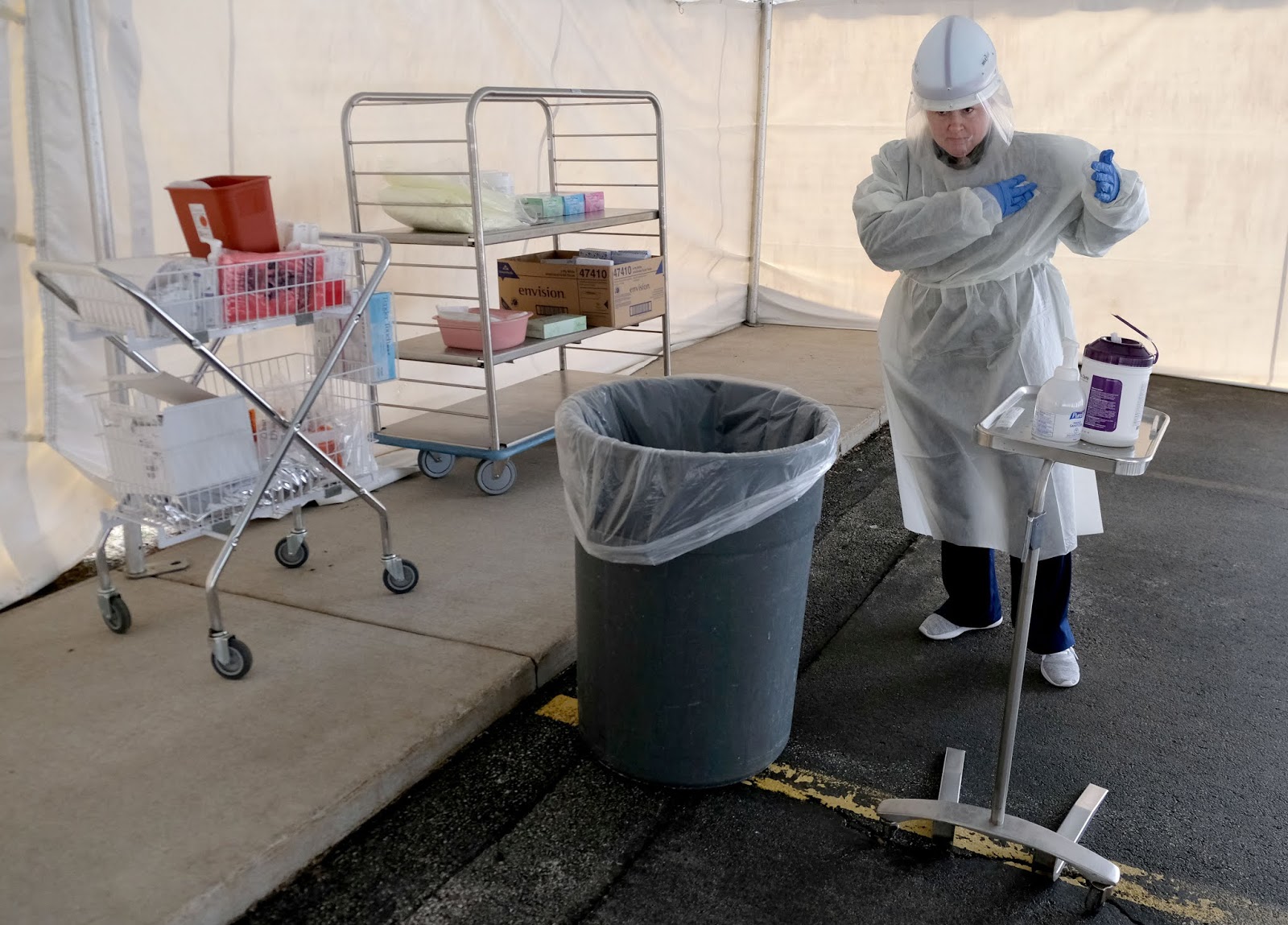
A St. Luke's nurse tests a patients for COVID-19 in a drive-thru tent.
   “I know Maria said it’s okay to say no,” said Julie Wolfe, “but me and our company have put in some really strict safety rules, and they aren’t suggestions. Our policy is ‘you are not allowed to do this.’ Crews are so used to getting those great shots and sound, and every day I have people ask me, ‘Can I do this?’ and the answer is no.
A St. Luke's nurse disinfects her protective clothing.
   “What I try to tell them is that instead of trying not to get sick, assume you already have it and try not to spread it. It’s not worth it to spread it to that feature interview. If you talk to the mayor, governor and the health department all in one day, you don’t want to be the one responsible for infecting those folks. I think that mindset has been really helpful for them,” she said.
   “There is tremendous pressure and stress, and I feel responsible for my team and want to keep them and my community safe. We can be the pollinators and honeybees going from person to person, and I don’t want that to be us,” Wolfe said.
   Wolfe added that if we are going on tv every day and telling people to keep social distancing and flatten the curve, then turn around and do the exact opposite, that just breaks down our trust. It is important for us to live what we are telling people to do.
   As photojournalists continue to cover this pandemic on the front lines, the fear of becoming exposed is real. We are not immune. So, when asked by Akagi if he had any media members who have come down with COVID, Matt Mrozinski’s answer wasn’t shocking.
   “Funny you should ask that, because just today we had a staff member test positive for COVID,” he admitted.
   “It’s a very real thing here. We always knew that eventually this was going to happen to us. We try to take every precaution known to man, but I’m sure this individual won’t be the last. When we heard that news, we were obviously concerned. The person’s doing better now, but you start thinking about who did that person work with, who was the last person they came in contact within any way? Fortunately, there were very few people that reporter came in contact with, and the individuals who worked alongside that person are quarantined at home.
   “Some of the rules we had in place here really prevented this from being a lot worse, like keeping crews/pairings together as best as humanly possible and letting them work out of separate cars.
   “My goodness, this could have been through the newsroom. Yeah, right here at home at KING-5, we have it,” Mrozinski said.
   Joe Little, an MMJ in San Diego, said that from day one the pairings at his station have been assigned and will stay together for the duration.
A Toledo BMV worker keeps customers limited to one at a time.
“It’s that further level of containment,” he said. “No shared gear. No shared cars. No shared crews. And we have fewer and fewer people in the building. If one person goes down, we hope to keep it isolated. It’s a challenge because we can’t go inside homes and restaurants, and I can’t use my lavalier,” Little said as he bowed his head in frustration. “But we adapt, preserver, overcome, and we keep working.”
   Staying safe was certainly a hot topic, but there were other important and relevant discussions throughout the 1:40-minute webinar, like managers needing to listen to the fears of their employees; balancing positive and negative news stories; being mindful of addictions while being at home more; reaching out to people when you need them; and being aware of your rights when covering hospitals, and understanding HIPPA regulations.
   Akagi concluding the NNA first town hall by saying that we are going to get through this. We are going to survive.
   “We just need to keep our wits about us, and I know that this town hall has reached out to a lot of you and will help you out. We really appreciate everyone who tuned in tonight,” Akagi said.
   To view the NPPA Town Hall webinar, go to the NPPA Facebook Page.

Monday, March 23, 2020

Telling the visual story of our lives during the COVID-19 pandemic

Story and photos by Lori King
Toledo Blade Photojournalist
   The severity of the COVID-19 pandemic first started to really sink in when my daughter received a text from a friend that Ohio State was suspending face-to-face instruction and going online.
   Jolee was already home from OSU for spring break. We were in the living room watching TV when she looked at me with disbelief and read me the text. We thought it was a hoax, but moments later she received the official OSU email, and it was real. It was the evening of March 9.
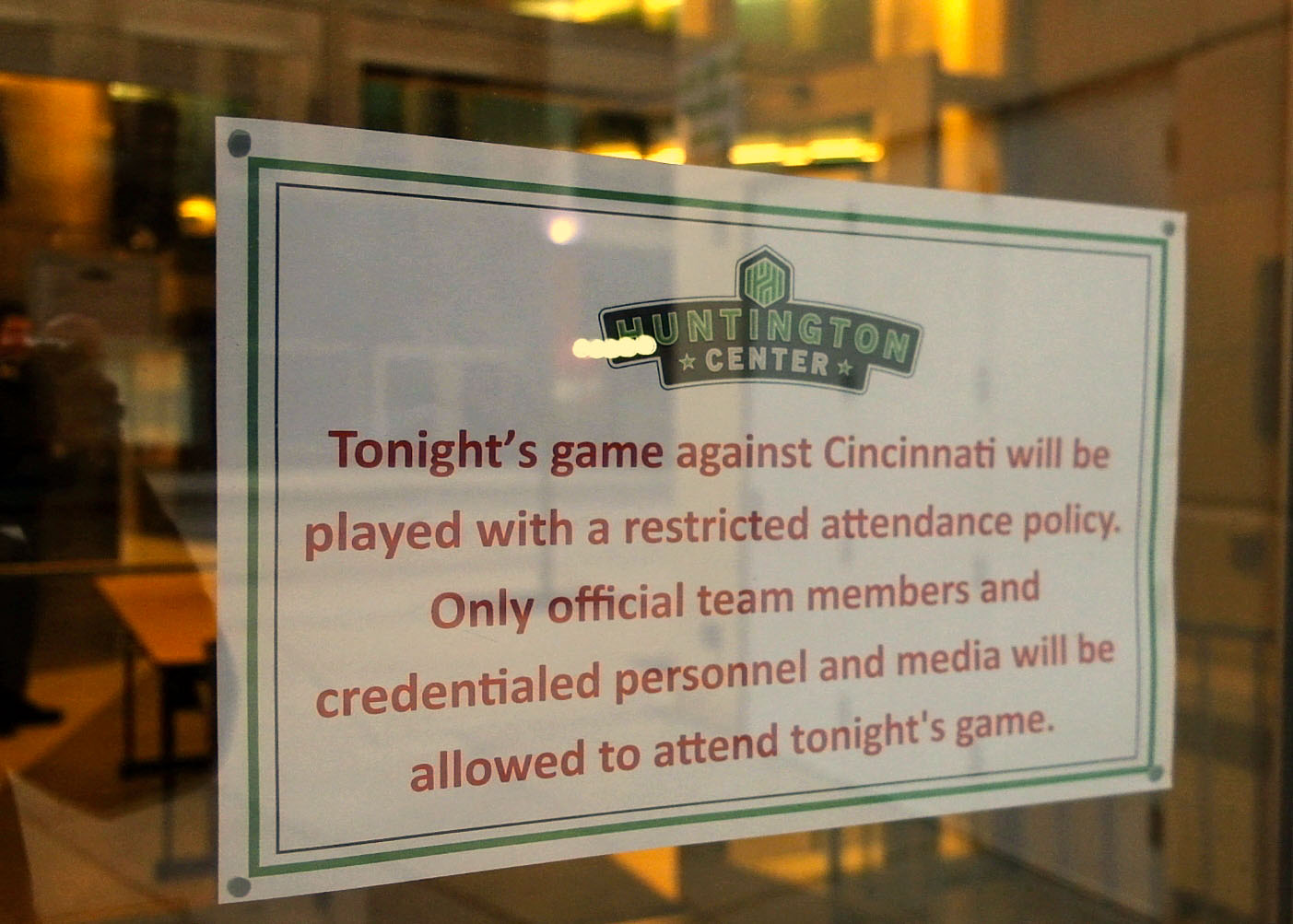
Posted on the entrance door of the Huntington Center.
   During the next few days, the University of Toledo, Owens Community College, Wayne State University and Kent State University all shuttered their classrooms and went online for what would end up being for the rest of the semester. These are schools where I currently teach as an adjunct, so I am on the other side of this, and currently scrambling to modify or cancel assignments and change deadlines.
   We have since moved Jolee, 18, out of her dorm, and our other daughter Quinn, 20, a UT student, has chosen to stay with us rather than be alone in her campus apartment. We have our kids back.
   The school closings are probably what made it real for them, but for me it was when I covered the last home Walleye game at the Huntington Center on March 11.
   Loudly blaring from outdoors speakers above the entrance doors at the Huntington Center was a looping announcement: 
One of about 10 fans in the empty stands cheers for the Walleye.
“Tonight’s game against Cincinnati will be played with a restricted attendance policy. Only official team members and credentialed personnel and media will be allowed to attend tonight’s game.”
   It was even more surreal on the inside. If you’ve ever attended a Walleye hockey game, you know how loud and rowdy it can be. But on this night, there were only about 10 fans (family members of hockey players and staff) in an arena that holds 8,000 people. You could literally hear players yelling to each other, skates digging into the ice, and pucks hitting the protective net. The silence was unsettling.
   As Blade photographers on the front lines of this pandemic, I believe it is our responsibility to show the public what is happening out there. While most citizens are forced to hunker down in their homes to help prevent the spread of COVID-19, we are out in the community visually telling the story of our lives.
Walleye GM Neil Neukam talks with Huntington's GM
Steve Miller on an empty floor, in front of a closed store.
For the past few weeks, we have been documenting men and women buying guns for self-protection, nurses testing sick patients for the Coronavirus, airport security agents disinfecting bins, BMV workers restricting access to their offices, college students prematurely moving out of their dorms, restaurant and store owners volunteering to pack food for delivery to the young and elderly, and panicked people stockpiling toilet paper and hand sanitizer.
   To tell this story of worldwide disruption and fear due to this aggressive and deadly virus, photojournalists and journalists around the globe must be able to roam free, and given unprecedented access. That is the only way you can see and believe what is really happening.
   As a Toledo Blade photojournalist, and I think I can speak for my colleagues, as well, I consider it a privilege to show you how humankind is dealing with a virus that might knock us down for a while, but not out.
   We shall overcome, and I need my daughters to believe that.
Walleye goalie Billy Christopoulos makes a save against Cincinnati.
Walleye fan Ryan Shaffer boos Cincinnati. Shaffer is a family member of the Walleye athletic trainer.
Dan and Cheryl Milan, the parents of Cincinnati player Cody Milan, can literally sit anywhere they want.
The helmet of Cincinnati's Kurt Gosselin flies off as he fights Walleye's Tyler Spezia. Sometimes you just gotta fight.

Thursday, March 12, 2020

Devising a plan: Going from face-to-face teaching to alternative delivery

Dear students,
Let me begin by saying if was a pleasure to meet you all in person. I know that sounds weird, but there it is. We can no longer take that wonderful, valuable in-person communication for granted. Some of you I might see soon, but others I won't … Sigh.
Because of precautions taken to limit the spread of the coronavirus, my classes have either went online for at least two weeks, or are finishing out the semester online. Rather than write four separate emails, I'm addressing plans for each of my courses here in one single blog post.
Fortunately, all of you are accustomed to me sharing everything on Blackboard/Canvas. That will make it easier for you to understand my online instruction moving forward. The following are positives regarding your course going online:
  • There are no more tests. So you don't have to worry about that.
  • The rest of the assignments can be done using your smartphone, if need be. That means you won't have to worry about getting access to the technology in the classroom. If you do need/want Photo Mechanic, Photoshop, Adobe Premiere Pro, or Adobe Elements/Premiere, you can get a free 30-day trial!
  • You are already accustomed to submitting your assignments online anyway, on your website and social media.
I'm going to break down how each class will run during our mandated online course instruction period.

KENT STATE UNIVERSITY – Digital Media online grad class
No change in instruction.

OWENS COMMUNITY COLLEGE – Visual Storytelling
Online teaching method for the remainder of the semester.
This means we will communicate online until at least April 6, which is when our first day back in class is scheduled. I'll go in and modify the due dates and instructions within the next few days.
The following are plans for the podcast and feature story assignments:

Visual Storytelling class tours Media Center, where podcasting magic happens.
Podcast assignment:
- For those of you who have already recorded your podcasts, hang on to the files and you will produce them when we get back to class. However, if you have software at home, or want to get a 30-day trial of Adobe Premiere Pro, or try the free version of Audacity, then go for it. I have tutorials on this blog. I can also help talk you through it. I've already emailed you the intro, outro and music file.
- If you have not recorded your podcast yet, you have two options:
  1. Wait until in-person courses at Owens resumes, then schedule your podcast with your guest and Herbey, or …
  2. Use your smartphone audio app or other recording device and interview a person of your choice on a topic of your choice. It can be on any subject, and with anyone. Maybe talk about how this stupid virus is interfering with our lives!
- You can all wait to produce the podcast show during class, if we come back. If we don't come
back, then I'll address that issue at that time.

Feature photo story assignment:
-You will have to change your story subject, obviously, considering on-campus stories are off limits for now.
  • So, you have two options:
  1. shoot a photo story of your choice, and produce it using your smartphone editing apps. You can actually do this entire assignment on your smartphone. There are still events going on around Toledo, as long as they involve fewer than 100 people. But this depends on your comfort lever. I won't force any of you to go out in public if you don't want to, or ...
  2. Wait until we get back to campus and do your original plan.
  3. Know that deadlines will be moved back to accommodate these trying times.

UNIVERSITY OF TOLEDO – Photojournalism
Online teaching method for the remainder of the semester.
University of Toledo pj student Lori Cooper shows off her woody camera.
This means we will communicate online until at least March 31, which is when our first day back in class is scheduled. I'll go in and modify the due dates and instructions within the next few days.
The following are plans for the feature and sports assignments:

Sports assignment: Canceled. All of the sporting events are being canceled, so there is nothing to shoot, unfortunately.
  • However, I'll post the assignment so you can still get valuable information on how to shoot a sporting event.
Feature photo story assignment:
- You might have to change your story subject if you planned on covering something on campus. But there might be other things to shoot off campus, like pet adoption centers, unique restaurants, etc. Think outside of the box, and do something unique that will lend itself to visual variety.
- Since you are using your smartphone as a camera, you won't need the classroom to use the technology.
  • So, you have two options:
  1. shoot a photo story of your choice, and produce it using your smartphone editing apps. You can actually do this entire assignment on your smartphone. There are still events going on around Toledo, as long as they involve fewer than 100 people. But this depends on your comfort level. I won't force any of you to go out in public if you don't want to, or ...
  2. wait until we get back to campus and do your original plan. But you know what happens when you wait until the last minute ... 

WAYNE STATE UNIVERSITYDigital Photojournalism
Spring break is extended for students and all classes canceled until March 23. After March 23, we will resume an online method for the remainder of the semester.

Wayne State digital photojournalism students learn the power of manual.
Sports assignment: Canceled. All of the sporting events are being canceled, so there is nothing to shoot, unfortunately.
  • However, I'll post the assignment so you can still get valuable information on how to shoot a sporting event.
  • If, by some miracle, you find a sporting event that's still going on and you want to shoot it and post it according to the assignment instructions, go for it. Extra Credit!

Feature photo story assignment:
-You might have to change your story subject if you planned on covering something on campus. But there might be other things to shoot off campus, like pet adoption centers, unique restaurants, etc. Think outside of the box, and do something unique that will lend itself to visual variety.
- Since this is with your smartphone, you won't need the classroom to use the technology, and that's a good thing.
  • So, shoot a photo story of your choice, and produce it using your smartphone editing apps. You can actually do this entire assignment on your smartphone. There are still events going on around Detroit, as long as they involve fewer than 100 people. But this depends on your comfort level. I won't force any of you to go out in public with lots of people if you don't want to.

All students: Know that deadlines will be pushed back to accommodate these trying times. Come up with ideas for these assignments. Remember, you are a photojournalism student, so you have a unique opportunity to tell how this virus is effecting people's lives. Pay attention to the news, and if an idea comes to you, let me know!

The final assignment:
I'll let you know what I plan to do.

Stay tuned …

Saturday, September 7, 2019

Integrated Media: A new UToledo course for 21st Century journalists


Hear ye, hear ye:
Bright and early on the morn of Tuesday, August 27, at the obnoxious dawn hour of 8 a.m., I officially became a Toledo Rocket!  
I humbly and enthusiastically greeted 16 students who willingly (an elective) signed up for a new, curious course taught by an instructor they undoubtedly have never heard of. 
So let the collaborative learning begin!
   But seriously, I’m super excited and honored to introduce a new course in the University of Toledo’s communications department called Integrated Media, which is basically mobile journalism (MOJO). As defined by Mobile Journalism Manual, MOJO is a form of digital storytelling where the primary device used for creating and editing images, audio and video is a smartphone.
   This is the future of journalism, and the future is now.
Toledo Blade reporter Brooks Sutherland gets his MOJO on.
   In the summer of 2018 I was struck with the idea to teach this course because most Toledo Blade journalists are now using their phone cameras to shoot video stories. They literally stand right next to us photogs, both of us shooting our subject at the same time. This leaves no doubt that it's time for university journalism programs to prepare its students to walk into newsrooms ready and able for MOJO. 
   In full disclosure ... I first resisted the idea of journalists doing the job of photojournalists. After all, we are trained for visual work, not most of them. Many of us have photojournalism degrees, or at least a photography background. We have a trained eye and understand camera operations, but not most of them. 
   But these days that doesn't matter. Regardless of visual experience, journalists in newsrooms across the country are handed a smartphone and told to replace us. I dare say the quality of the content certainly suffers. And I question whether it's fair to either of us. But it doesn't matter, because that's the way it is these days.
   So, my ultimate goal for this course is to help students develop a MOJO frame of mind, and to guide them along as they construct and maintain a MOJO workflow for their smartphone storytelling. By exclusively using their smartphones to create and produce native content to disseminate on social media, they will hopefully learn to trust their phones for visual and audio content.
   During the first week of class the students set up a website, and linked Twitter and Instagram to it. YouTube will be added later. But before they start to put their work out there for the WWW to see, they will first learn to be responsible MOJOs by learning their ethical and legal boundaries, their copyrights, and, of course, the First Amendment. They will also learn AP style caption writing, and about audience engagement and analytics.
   Because this is a new course, I will have a learning curve, as well. I don’t typically shoot stories with my smartphone (iPhone 8) because I don’t have to. I use my Canon 5Ds and a Fujifilm X-H1 on most assignments, particularly when shooting sports. Let’s face it, the smartphone is definitely not cut out for replacing long, fixed lenses. However, there are times when I use my phone camera, particularly for breaking news. Timeliness is the key in those situations.
   That said, I need to practice what I teach, so last week I shot a simple, short video story on my iPhone (except the actual interview was recorded on my Fuji because I needed an external mic). That story is below:


   Can you tell it was shot on a smartphone camera? Can you tell the difference between the moment clips and the X-H1 interview? 
   Although I edited this story on a MAC laptop using Adobe Elements Premiere, I am teaching myself to edit on my iPhone using iMovie. I must be able to pass what I learn along to the students. But let's be real here ... many of them will actually teach me a few things! Yes, I expect to learn from them, as well, which is why I consider this class to be ‘collaborative.’
   So, stay tuned to see how this course develops in the next few months!
   Thank you, UToledo, for this great opportunity!